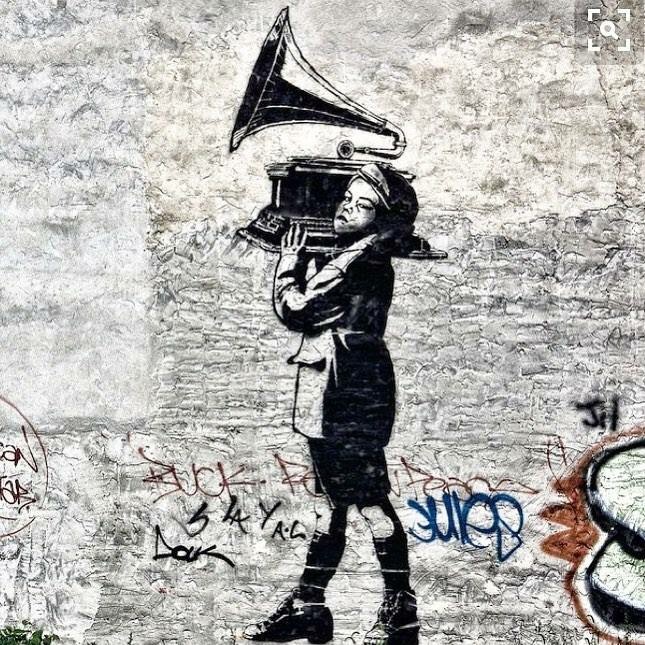

I miss record stores. I miss them the way someone who lost a limb still feels the itch, sometimes the pain. The way you miss a dear but long-lost friend.
The record store wasn’t the place where you bought a record, like you buy a shirt or a cookie. Well, it was, but it wasn’t.
It was where you met words and music that’d be with you for an instant or a lifetime; the songs that you would sing, dance, tap, headbang, clap, whistle, play air guitar, cheer, remember, forget, sway, groove, bop, harmonize, stomp, swivel, lip-sync, pump fists, nod heads, tap toes, jam, vibe, belt, swing, swoon, pogo, mosh, smile, cry, kiss, and croon to.
It’s where you met poetry and yearning and a feeling that somewhere out there there was someone who’d written something that was SOMETHING, you know?
I met my first record store when I was ten, maybe nine.
It was a hole in the wall with an aisle you could walk back and forth in six strides, four record bins on each side, bursting with vinyl LPs in no apparent order. It didn’t sell tapes, and CDs were still years away. The walls and ceiling were plastered in rock band posters. Two speakers hung from the ceiling, blasting nothing but the best 70s rock & roll. AC/DC said it best: I was Thunderstruck.
The owner would make you listen to a record before you could buy it. You read that right: he wouldn’t sell you a record unless you listened to at least two tracks. Nothing like the megastores of the nineties.
At that store I met Michael Jackson’s Thriller, Madonna’s Like a Virgin, Springsteen’s Born in the U.S.A, Prince’s Purple Rain, Dire Straits’ Brothers in Arms, Bon Jovi’s Slippery When Wet, and the three albums that basically shaped my music taste forever: Metallica’s Master of Puppets, Guns N’ Roses’ Appetite for Destruction and U2’s Joshua Tree. These three are perfect, no skips.
That store went under a few years later. I’m sure the no sale without a listen policy had something to do with it, but it saved me from buying A-ha’s Hunting High and Low and Simple Minds’ Once Upon a Time when I only liked Take on Me and Don’t You Forget About Me; great songs, terrible albums.
I found other stores, other records.
A record store gave me my first job. I was fourteen and wanted, scratch that, needed to buy a Sony Walkman. Today we take portable music for granted. We carry most songs we’ll ever want to listen to in our pockets. Back then, before the Walkman? Forget about it. You could listen to a record at home, or you could listen to whatever the demigods anointed as DJs played on the radio. In 1990 Mexico, said demigods would limit themselves to a Top-40 Hit Parade and little else. A Walkman would free me from the demigods and my mother’s endless demands to turn down the volume and, please, son, do you really have to listen to that awful thing?
The awful thing was Depeche Mode’s Personal Jesus, so yeah, I needed a Walkman, and the road to my Walkman led through a summer job at Mixup, Mexico’s largest record store chain. Two glorious months helping others find the right band, the perfect song, for whatever spirit was moving them. The store didn’t have listening stations yet, but people could have a record opened and sampled before buying it. I made sure all my customers did. I kept more than a few from making the mistake of going home with Vanilla Ice.
September came, and with it Middle School, but I was ready. I had a Walkman. From then on, it was tapes only for me. Bought albums, mix-tapes, music I recorded from the radio, most times with the DJ’s impertinent voice talking over a song’s intro or outro; I could take my music with me, listen to it wherever, whenever, until the tape got mangled from playing it over and over and over, and I had to buy the album once again or try (and fail) to replicate the mixed tape.
On Sunday afternoons, my friend Marcos and I would grab a burger and a soda, Quarter Pounder for me, Big Mac with extra sauce for him, and hit the mall’s Mixup. We’d spend long hours at the store’s listening stations. These were freestanding spots with headphones, where you could check out that week’s Billboard top-fifty albums. Those listening stations introduced me to some of my life’s greatest loves: Metallica’s black album and Pearl Jam’s Ten in August, Guns N’ Roses’ Use Your Illusion I & I, Nirvana’s Nevermind, Red Hot Chili Peppers’ Blood Sugar Sex Magik, and Soundgarden’s Badmotorfinger in September. I don’t know that there’s ever been a better music vintage than August and September 1991, with U2’s Achtung Baby a sleeper crux for that year’s November.
I met other loves at the record store. The fleeting, less significant, of flesh and bone type. The record store was the pickup spot for teens like me. We were too young to go clubbing, and too eager to share a tune and a kiss or two at the movies.
There was nothing better than spotting a girl with her eyes closed, headphones on, tapping her foot to a song you liked. It was as if Bono himself (or Kurt, or Axl, or James; you get the idea) was telling you: “This one, boy. This is the one. I can’t say if she’ll be with you for an hour or a year, or at all, but take your shot, see how it goes,” and if it didn’t go well or at all, as was usually the case, you still shared those four minutes of song that you both liked.
I outgrew those days, but not the record store. It morphed from a place of discovery to a place of reaffirmation. I’d go back, week after week, with a list of songs I’d heard at the nightclub or a party or a girl’s house or the radio; and buy the album if I still liked it dry and sober. Most didn’t make the cut.
And then Napster came.
Napster was the first wave of a cataclysm.
It allowed us to share and download MP3 music files from our friends’ computers, bypassing the record store. Napster conditioned us to expect free or low-cost music, destroying our purchasing habits and expectations.
To my shame, I was a Napster enthusiast. I didn’t understand when Metallica sued it out of business. I was angry at them for having the audacity, the fucking audacity, of wanting payment for their music. Wasn’t my fandom enough? Didn’t they charge so much for their concerts? Their merch? Weren’t they rich enough already? It turned out Metallica would weather the storm unleashed by Napster and the clusterfuck that was Livewire. They would thrive and ride the lightning (see what I did? hahaha) that were Pandora, iTunes and Spotify. Artists like them, and like those who’ve followed in their footsteps, kept on keeping on, and flourish. Record stores floundered.
“Each man kills the thing he loves,” wrote Oscar Wilde. It was true in 1889. It was still true a century and change later when Eminem said it. I loved record stores. I still do, and I killed them. Not on my own, of course, but mine was one of the million cuts that did it. Mea culpa. Mea culpa. Mea gran culpa.
Today I miss record stores. I miss them in the way one misses an essential thing he took for granted until one finds it gone. There are still some out there, in the wild, but none close to me. Many of them are not unlike the first one that found me: small, stocked with vinyl albums, owned and managed by people who care more about the music than the music business, priests of a dying cult, unsung heroes who are fighting a losing battle because it’s worth to fight it, with no expectation or real prospects of winning. My heart and gratitude go out to them, and every time I find one, so does my money. It’s the least I can do.
Discover more from Alberto Mansur
Subscribe to get the latest posts sent to your email.

Hermosa descripción, revivir esos tiempos, te llenan de nostalgia y avivan tu corazón, quizá es una frase trillada, pero es cierta. Le agradezco, compartir sus recuerdos. Saludos afectuosos.
Enviado desde mi iPhone
LikeLike